Written by Winchester House Historian Janan Boehme, July 8, 2026
Did you know that Sarah Winchester’s father-in-law Oliver Winchester, founder of the Winchester Repeating Arms Company, actually made his fortune selling men’s shirts? Without Oliver’s success in the clothing business, it’s not likely that you would ever have heard of a Winchester rifle.
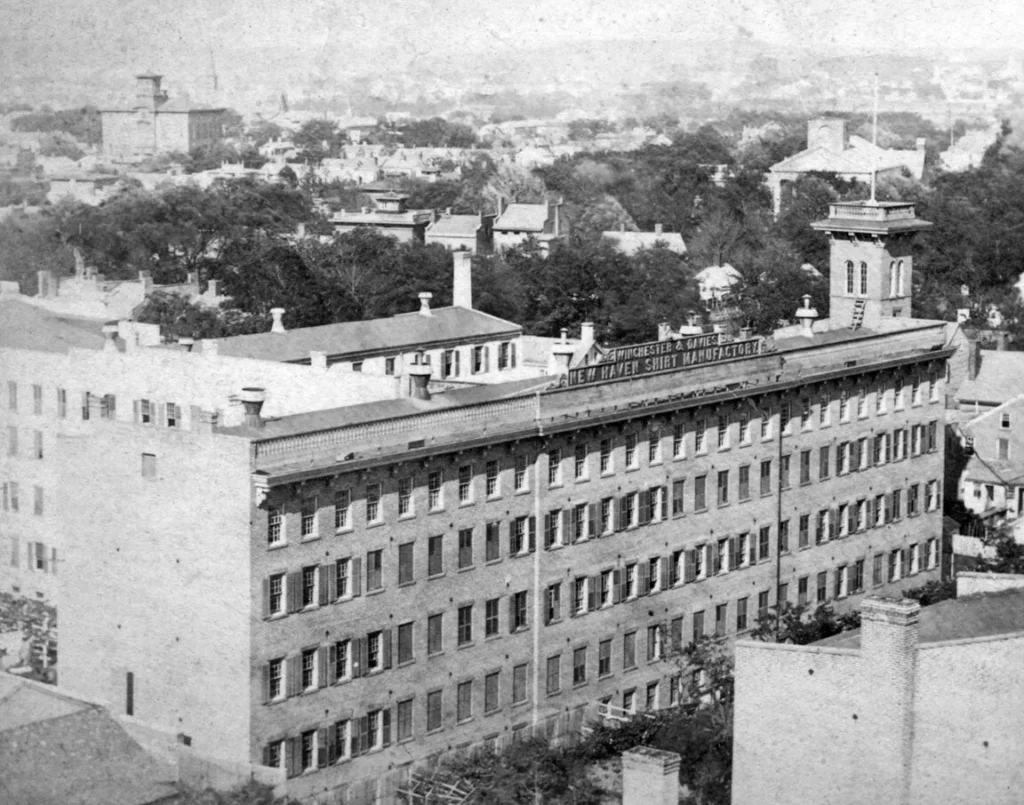
Winchester & Davies Shirt Manufacturers, c. 1860s. Courtesy Joe Taylor.
It was the money made by the Winchester & Davies Shirt Manufactory in New Haven, Connecticut that allowed Oliver Winchester to invest in a fledgling gun company—the Volcanic Repeating Arms Company—in 1855. Volcanic was originally the Smith & Wesson Company, and Daniel Wesson continued to manage Volcanic Repeating Arms after Winchester became an investor. But less than a year later, Wesson and Horace Smith got back together to start up the Smith & Wesson Revolver Company.
At Volcanic, Winchester met Benjamin Tyler Henry, inventor of the famous Henry rifle, the first dependable lever-action repeating rifle. This 16-shot .44 caliber rimfire breech-loading rifle was a vast improvement over the single-shot carbines commonly in use at the time. By late 1856, Winchester acquired controlling interest in the Volcanic Arms Company, and moved it to New Haven, where it was reorganized as the New Haven Arms Company. He hired B. Tyler Henry to superintend his new firearms factory.
Once Henry was finally granted the patent on his invention in 1860, Oliver Winchester’s New Haven Arms Company produced and sold it as the “Henry rifle” until 1866.
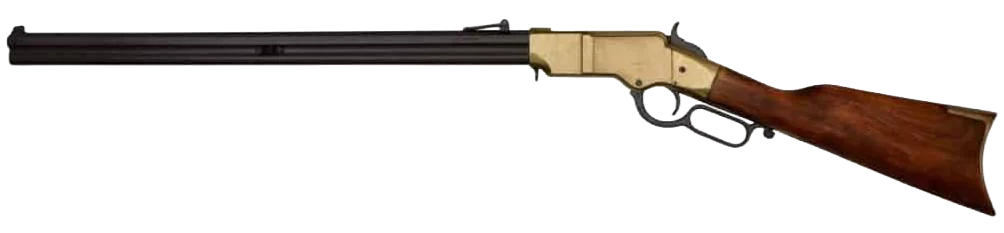
Henry Rifle, invented by Benjamin Tyler Henry in 1860.
In 1860, the Civil War was coming fast, and Winchester tried selling his repeaters to the U.S. military, assuming they’d give a big advantage to Union forces: most soldiers at the time were equipped with Sharps or Springfield carbines that needed reloading after every shot.
But the military decided to stick with what it knew and trusted. They claimed that “uniformity of arms” was best and that soldiers would likely waste ammunition if they were able to fire 15 or 16 rounds without having to re-load. But the soldiers themselves could—and did—often buy their own rifles, and thousands chose the Henry.
Winchester kept hoping that the military would change its mind, and he wasn’t happy with what he considered poor production levels at the New Haven factory. When Henry was unable to deliver guns fast enough to suit him, Winchester hired Samuel Colt’s Hartford manufactory to assemble 400 Henry rifles for him, a move that apparently angered Henry. After that, Winchester leased a factory in Bridgeport—about 20 miles away—to raise his production capacity.
By 1864, Winchester apparently accepted that the military wasn’t going to buy his rifles, and he sailed off to Europe to demonstrate them in various cities around the Continent, and try to pick up new contracts. He left Henry in charge, armed with a power of attorney signed by Winchester that essentially allowed Henry control of the company. Henry must have been extremely unhappy with Winchester, because he used his power of attorney to take over the New Haven Arms Company, and file papers to reincorporate as the “Henry Repeating Rifle Company.”
Needless to say, Oliver Winchester didn’t take this lying down. He couldn’t really stop Henry’s takeover, given the power of attorney, but he instructed his son William and his friend and business partner John Davies to call in the personal loans that he had given the company, and William and Davies removed all Winchester monies from the New Haven Arms Company.
Next, Winchester filed papers to create the Winchester Repeating Arms Company, based in the Bridgeport factory, which was already producing guns. With ample financing from Winchester and Davies, the new company was in good shape. The new Henry Repeating Rifle Company, however, was broke. Winchester bought it the following year, paid its debts, and made it part of the Winchester Company. Up to now, Winchester had been happy to have Henry’s name on the rifle Henry had designed, but now that would have to change.
Winchester hired Nelson King to alter and improve the Henry rifle design, and the result was the Winchester model 1866, also called the “Yellow Boy” for its shiny brass receiver. And that’s how the Winchester rifle was born.
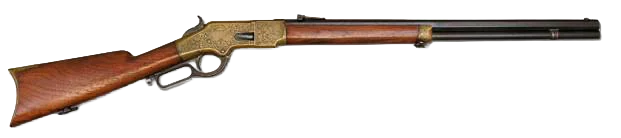
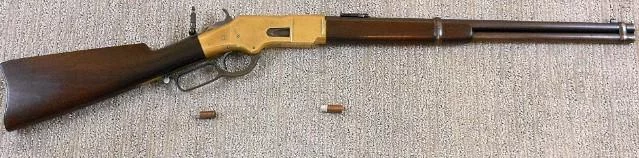
Winchester Rifle, model 1866.